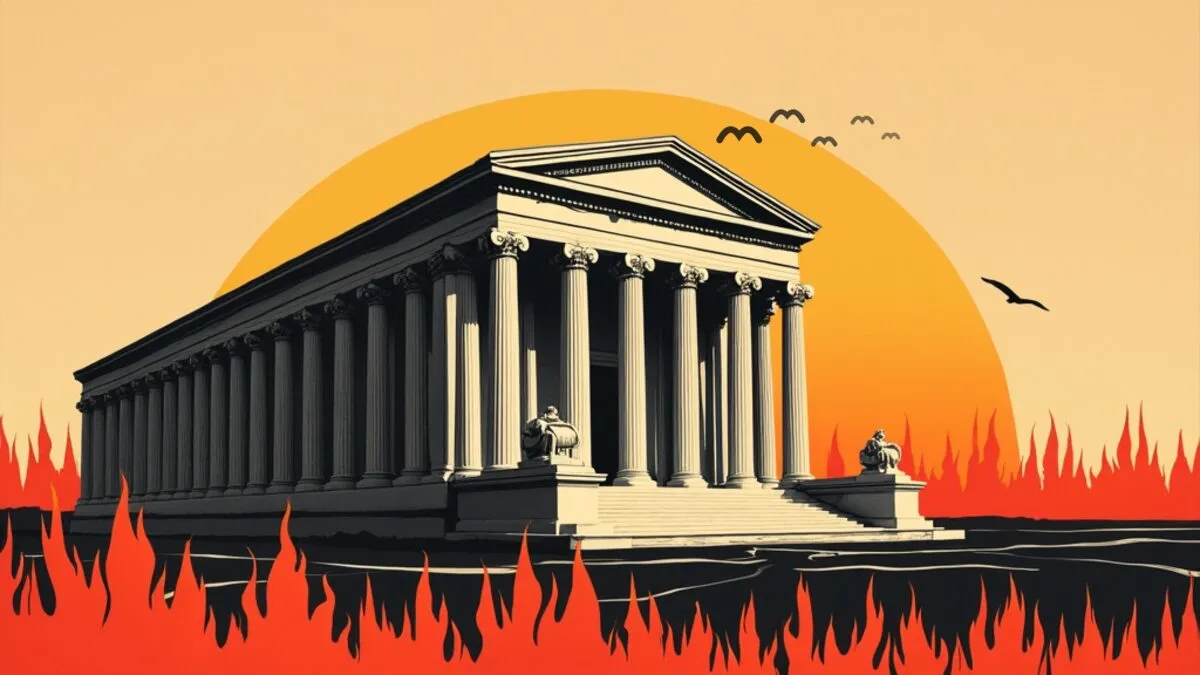
On Monday, the United States Supreme Court heard the case that will decide who pays for the burning.
Boulder County and the city of Boulder filed suit in 2018 — not a federal agency, not a regulator, just two local governments asking a simple question under Colorado tort law: when a company's product changes the climate, and that changed climate burns through a county's infrastructure, its public health, and its residents' homes, does the company share the cost?
The answer is no longer Colorado's alone to give. The defendants — Suncor Energy, the Canadian oil giant that operates Colorado's only fossil fuel refinery, and ExxonMobil — have asked the Supreme Court to quash the lawsuit entirely. Their argument: federal law preempts state tort claims for damages allegedly caused by interstate and international greenhouse gas emissions. If they win, the logic does not stop in Boulder.
Eight years, no trial
The procedural history is its own story of endurance. The suit has been pending since 2018. The companies tried — repeatedly, and repeatedly failed — to have it dismissed or removed to federal court. In May 2025, the Colorado Supreme Court ruled the case may proceed in state court. Soon after, the companies asked the U.S. Supreme Court to step in. In February, a court with a 6-3 conservative majority agreed to hear it.
It is worth pausing on the posture. Eight years after the complaint was filed, the case has not yet reached trial. No damages have been quantified, no evidence heard. What the Supreme Court will decide is not what happened, but whether what happened can even be asked about in court.
An unsolicited brief
The Trump administration has entered the case. Not as a party, but by filing — in an unusual move — an unsolicited brief supporting Suncor's and Exxon's petition, calling the Colorado Supreme Court's decision "contrary to the Constitution." U.S. Solicitor General John Sauer was allotted time at Monday's oral argument to make the government's case on the companies' behalf.
Chris Winter, an environmental attorney and executive director of the Getches-Wilkinson Center at the University of Colorado Law School, has been blunt about the pattern: "We've seen this administration really bend over backwards to serve the interests of the fossil-fuel industry, and this case is just one of many examples."
Thirty suits and counting
Boulder is not a lone case. Its lawsuit is one of more than thirty similar cases filed to date by state and local governments nationwide seeking climate-related damages from fossil fuel companies. A ruling that state law "precludes state-law claims seeking relief for injuries allegedly caused by the effects of interstate and international greenhouse-gas emissions on the global climate" would foreclose all of them at once.
The companies' own briefing puts the stakes in their own numbers: "The requested damages in any one case could reach into the billions," their attorneys wrote, warning that "every political jurisdiction in the Nation could bring a similar suit against any subset of the world's fossil-fuel producers."
That is the whole fight compressed: "potentially crushing monetary liability," in the companies' phrase — or, in Winter's, the question of whether "the oil industry [is] going to be at least partially responsible for their role in contributing to this crisis."
The Alito wrinkle
In another unusual development, Justice Samuel Alito recused himself from the case last week, days before oral argument. The court did not explain why. Environmental advocates had called for the recusal because Alito owns stock in at least two oil companies — and a recent analysis found his fossil fuel assets have grown by up to $2.9 million. He had already stepped aside from a separate environmental case involving the oil industry in January.
The timing has drawn criticism. Alito participated in the court's decision to take the case in the first place — a decision that requires four votes, which the court does not publish. "We don't know whether Alito's vote made the difference, and that uncertainty is precisely the problem," said Alexandra Nagy, organizing director of the nonprofit Consumer Watchdog. "If Alito was the fourth vote, this case should be dismissed."
What is at stake, on the ground
Colorado spent the summer in what can only be called a record: heat, extreme drought, and destructive wildfire activity. The state's local governments have been on the front line of all of those costs, and Boulder's attorneys make the case about who bears them: "Are those costs just going to fall on the shoulders of all of the taxpayers and citizens and our local governments?" Winter asked.
That question is the commons, in legal form. The atmosphere is not a product anyone owns. It is the most shared resource there is. And this case asks whether the people who profit from polluting it can choose the forum and shield themselves, forever, from the people who pay for it.
What happens next
The justices have heard argument. A ruling is expected later this term, and it will likely settle the preemption question for dozens of pending suits. Boulder's lawyers argue the court is far too early: nothing in the Constitution's text or in any legislation preempts a state's authority to try these cases under tort law, and the companies, they write, have "run to this Court at the case's outset" rather than letting the state judicial process play out.
Whatever the ruling, the underlying claim does not change. The costs of a changing climate are already here, already being paid, in counties and cities across the country. The only open question is whether the industry that caused them can refuse to share them.
SOURCES
- Chase Woodruff (Colorado Newsline), "Case at Supreme Court Could Have Profound Consequences for Other Climate Suits," Truthout, Oct 5, 2026 — https://truthout.org/articles/case-at-supreme-court-could-have-profound-consequences-for-other-climate-suits/
- Chris Walker, "Alito Reverses Course, Announces Recusal From Major Corporate Fossil Fuels Case," Truthout, Sep 29, 2026
- Chris Walker, "Alito's Assets in Fossil Fuels Have Grown by Up to $2.9 Million, Analysis Finds," Truthout, Aug 13, 2026
The Commons Floor (0)
No comments yet. The floor is open — be the first to add your voice.
Add Your Voice
The Commons Floor is for readers in the house. Sign in with your Google account to add your voice — no separate membership, no password to keep, and your comments stay yours.
Sign in with GoogleComments are read by a human with patience. Be as decent here as you would be at the kitchen table.