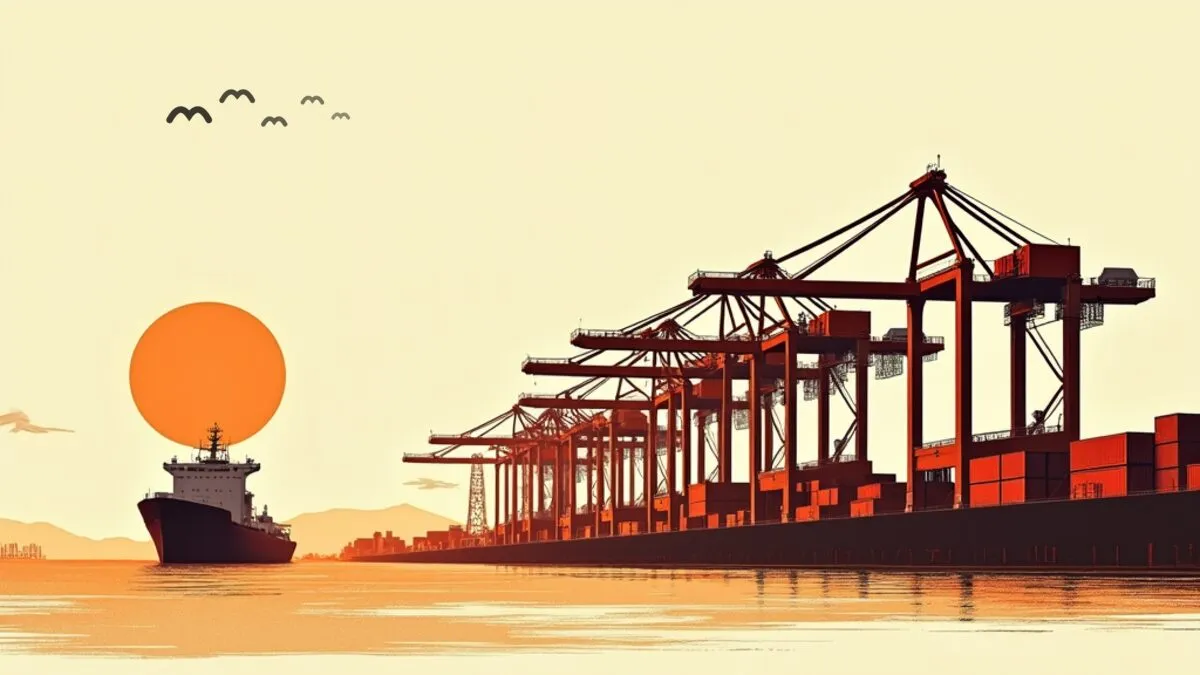
This Friday, October 30, the work stops in some of the busiest ports on earth — not because a contract has lapsed, but because the workers have decided what they will not do. By the count Jacobin gives it, dockworkers in roughly 100 ports across nearly 20 countries are preparing to down their tools for an entire day or an entire shift. The epicenter is the Mediterranean — dozens of ports in Italy, Greece, France, Cyprus, the Basque Country, and Morocco — with dockworkers and other workers also set to rally in Spain, Turkey, Germany, Ireland, Portugal, Denmark, Sweden, Australia, Veracruz, Mexico, Oakland, California, and ports across India.
It is the second International Day of Action of Dockworkers. The first ran February 6 of this year, when strike action was held in 20 ports across 7 countries. In May, trade union organizations from 35 ports met in Istanbul and formed a coordination network that now spans more than 40 ports across the Mediterranean and Europe, under a slogan that is doing the work of a whole platform on the posters: Dockworkers do not work for war.
A solidarity stoppage with a wage agenda stitched in
The organizers are careful about what the day is — and is not. The World Federation of Trade Unions, the Athens-based international that issued the call in September and claims affiliated unions representing 105 million workers, frames it under "Ports for Peace — Jobs with Dignity": the refusal of war bound together, in one document, with collective labor agreements, wage increases, stable employment, shorter hours, and real health and safety measures — and with opposition to the privatizations, subcontracted and temporary work, and automation that hollow out port jobs. Solidarity and bread, on the same picket line.
That is the shape of the argument that runs through the organizing, and it is the oldest shape in the labor movement. The ports are where the argument gets its leverage. Roughly 90 percent of the goods people consume, raw or finished, move by ship, by the figure Jacobin cites. As Charmaine Chua, a scholar of supply chains and organizer with Workers in Palestine, put it in the same piece: crude oil feeding the war machine moves through Turkey's Ceyhan port, coal ships out of South Africa, components for the Israeli arms industry roll through Genoa, Ravenna, and Livorno, and Oakland plays its own role supplying U.S. military operations. "If ports have become an astonishing crystallization of our states' callous complicity," Chua writes, "the immense solidarity of dockworkers and civil society reveals the mass opposition forming in response."
The call that this action answers comes from the other side of the water. In July 2025, the Palestinian General Federation of Trade Unions — the union federation of Gaza — issued a statement it named "A Cry Before Death," saying the war had destroyed 80 percent of homes in the Strip and all of its factories. To the port and seafaring unions of the world, it said:
Our union comrades, we await your role in delivering the cry of the children and workers of Gaza to decision-makers and to the streets.
The dockworkers have heard that cry before, and they have a long record of answering it with their hands.
The word "strike" has a nautical origin
The history runs deeper than the campaign. Peter Linebaugh and Marcus Rediker, in Many-Headed Hydra, trace the English word "strike" to 1768, when sailors in London struck — took down — the sails of their vessels and crippled the commerce of the empire's leading city. The labor movement's most powerful word was born at the water's edge, and the port has been the place to keep using it.
In 1935–36, dockworkers in San Francisco and in the southern African ports of Durban and Cape Town refused to load cargo for fascist Italy after its invasion of Ethiopia. From 1938, Longshore Local 10 in San Francisco refused, on several dozen occasions, to cross Chinese pickets — effectively boycotting all cargo bound for imperial Japan, with a Japanese Communist rank-and-filer, Karl Yoneda, coordinating alongside Chinese American neighbors. Against apartheid South Africa, union workers in San Francisco, Brooklyn, Sydney, Port of Spain, Gothenburg, and Copenhagen refused to handle the cargo. In 1978, when members of ILWU Local 10 found U.S. military supplies bound for Pinochet's Chile sitting on a San Francisco pier, they built a coalition — Chilean exiles, Bay Area Latinos, the Catholic Church, sympathetic members of Congress — and ran a successful boycott that helped push the Carter administration to stop the shipments.
The baton is in the Mediterranean now. Since 2019, when Genoa's dockers refused to load weapons for the Saudi war in Yemen, Genoa — Italy's busiest port — has emerged as a leading force, and its dockers have, by the account of labor historian Peter Cole, led hundreds of thousands of other Italian workers into general strikes in solidarity with Palestine, in concert with dockers from Livorno, Marseilles, Piraeus, Barcelona, Gothenburg, Casablanca, and Tangier. The American international longshore unions, by contrast, have been conspicuous in their silence — Cole notes that a pro-Palestine solidarity resolution failed to pass at the ILWU's International Convention last year — which makes the small American presence in Oakland and Veracruz on Friday all the more noteworthy.
In Genoa itself the action has a cultural dimension: through early November, the city is hosting HUM III, a sound installation by Hajra Waheed at the Port of Genova that traces maritime solidarity from Durban to Oakland, organized with the dockworkers' own groups and a community radio station. The organizers describe Friday as possibly the largest international port action recorded in history. Whether or not the ledger confirms that, the day is a test of something the labor movement knows from experience: that a supply chain can be interrupted by the people who run it.
No magic bullet — just the next step
The organizers are equally clear-eyed about the limits. Katy Fox-Hodess and Rafeef Ziadah, who have studied labor internationalism in the current war, argue that no single choke point is a "magic bullet": the supply chain that makes modern war possible is global, and closing one port, or one country's ports, is not enough. Chua's corollary is the one worth underlining — meaningful solidarity means finding the leverage points "in our own workplaces," and "building a unionism committed to organizing everywhere, rather than only at strategic sites."
Friday is a day of action, not a verdict. The WFTU's own framing is honest about that: October 30 can mark "a major new step in the international militant coordination of the working class" — a step, not an arrival. What the day records is what the port has always recorded: that the workers who move the world's goods can, if organized, stop moving its weapons. In 1768 that idea was new enough to need a word. It has a name now, and on Friday, in some hundred ports at once, it will be put to work.
SOURCES
- Jacobin, "Dockworkers Worldwide Are About to Strike for Palestine" (October 28, 2026)
- World Federation of Trade Unions, "30 October 2026 – 2nd International Day of Action of Dockworkers" (September 21, 2026)
- e-flux, "HUM III: From Port to Port, A Sonic Convening" (September 12, 2026)
- LAWCHA (Peter Cole), "'Scrap Iron Becomes Bullets': When Dockers Fought Fascism with Direct Action" (October 23, 2025)
- Masar Badil, "A Call from the Workers of Gaza to Labor Unions Around the World" (July 23, 2025)
The Commons Floor (0)
No comments yet. The floor is open — be the first to add your voice.
Add Your Voice
The Commons Floor is for readers in the house. Sign in with your Google account to add your voice — no separate membership, no password to keep, and your comments stay yours.
Sign in with GoogleComments are read by a human with patience. Be as decent here as you would be at the kitchen table.